
"Why has Advantage+ gotten so much smarter lately?"
Anyone who's used Advantage+ Sales will recognize this. A year or two ago the complaint was "it's shaky compared to a manual setup." Today it's common to see CPA coming in lower than manual.
The feature itself wasn't the change. The AI model underneath was replaced, wholesale. Codename: GEM — Generative Ads Recommendation Model.
What GEM is
The largest ads recommendation foundation model Meta has disclosed. In plain terms:
- Before: "many small AIs per campaign objective" (conversion prediction, click prediction, interest models, etc.)
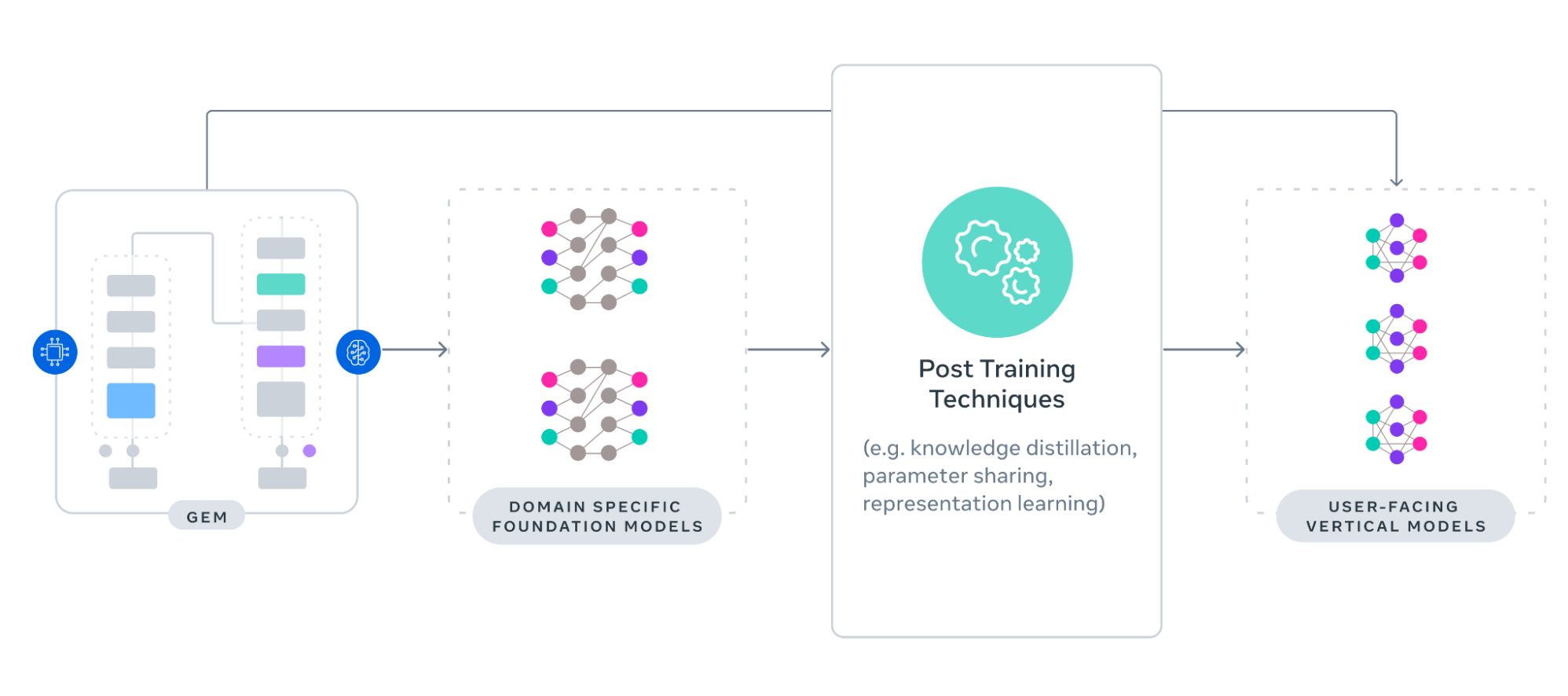
- Now: "one large foundation model (GEM) as the central brain" + "smaller downstream models inherit knowledge from GEM"
It's trained at LLM-scale (thousands of GPUs). Think of it as the "GPT of the ads domain."
Source: Meta Engineering — Meta's Generative Ads Model (GEM)
How much better is it actually?
Meta published official numbers (Q2 2025).
| Metric | Lift |
|---|---|
| Instagram ad conversions | +5% |
| Facebook Feed ad conversions | +3% |
In Q3, architecture changes reportedly doubled the gain per unit of added data. In other words, GEM is still growing, and it'll be better next year.
What changes for advertisers
GEM isn't a toggle you configure. It's baked underneath every ad product automatically. Advantage+ Sales, Advantage+ Catalog, regular Sales campaigns — all of them inherit GEM's improvements by default.
What advertisers notice:
- Faster learning on new campaigns — the old "50 conversions to stabilize" threshold is loosening. GEM's pre-training helps the learning phase converge even with thin seed data
- Better conversion quality on the same budget — not just more conversions, but better at picking high-intent users
- Advantage+ pulls ahead of manual more clearly — GEM benefits peak on Advantage+ (manual setups still benefit, but less)
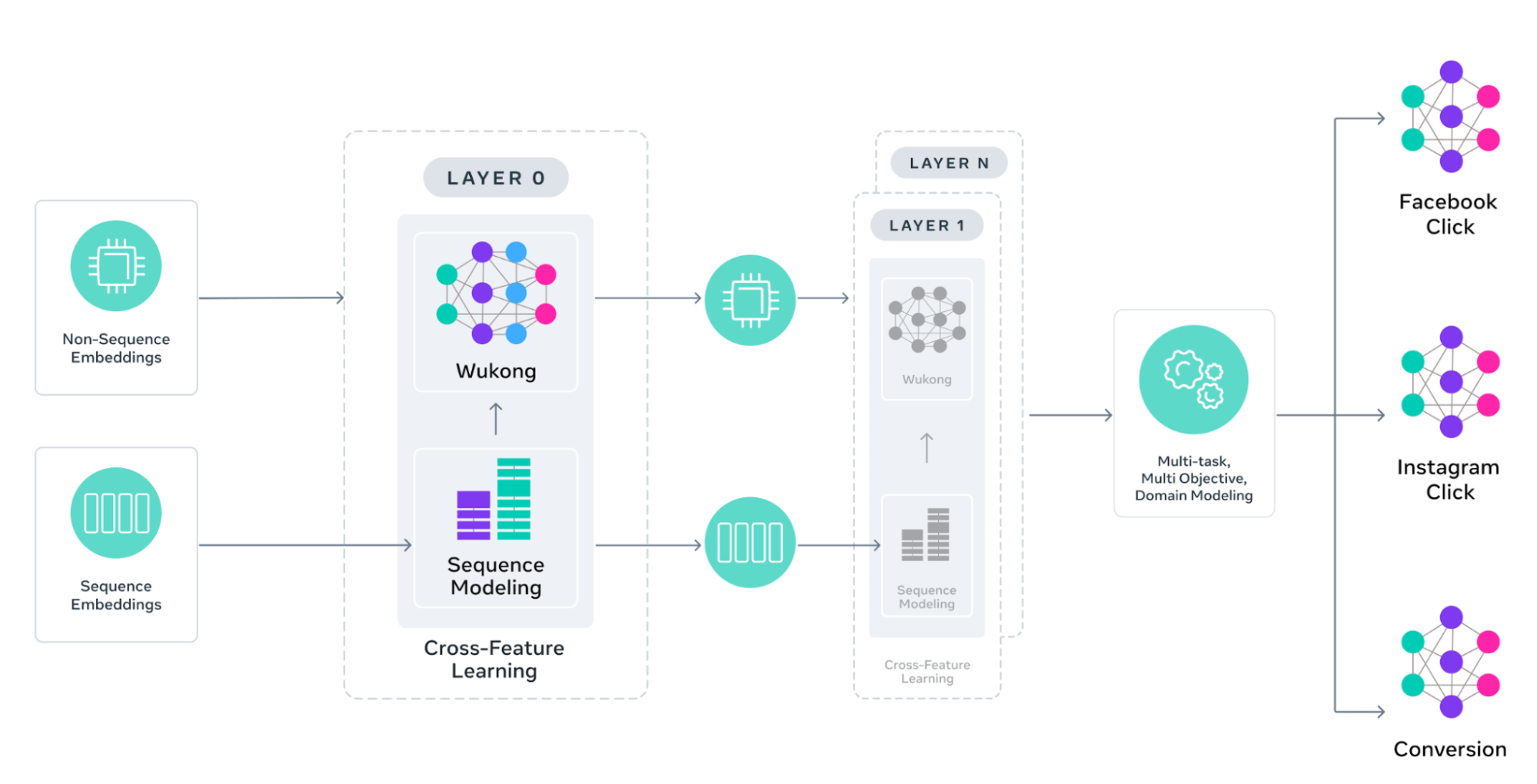
The core idea: once GEM learns something, that knowledge propagates across the entire ad model family. Unlike the old per-objective small-model setup, now when the central model improves, every downstream product improves with it.
So what should you do?
Honestly, not much. GEM applies automatically — there's no "enable" switch. But to maximize the benefit:
- Increase the share of Advantage+ campaigns — GEM benefits are bigger there
- Event quality hygiene — GEM needs clean signals to learn well. Pixel and CAPI setup, event deduplication, value/currency parameters — skip these and GEM can't do its job
- Supply creative diversity — more candidates, smarter GEM. 3–5 creatives per ad set as a baseline
- Don't touch campaigns mid-learning — resetting while GEM is converging cuts off the gains
Decision criteria: is your account missing out on GEM?
If 3+ apply, you're leaving GEM gains on the table.
- Pixel only, no Conversions API
- Missing value/currency parameters on conversion events
- 1–2 creatives per ad set, concentrated on a single winner
- Advantage+ is under 30% of your total spend
- Using custom conversions only, no standard events
If 3 of these ring true, fix them starting from the highest-priority one.
A note of skepticism
The +5% / +3% numbers come from Meta's own measurement. Numbers in third-party tools (GA, Northbeam, etc.) may differ. Still, the direction is clear: ads AI has shifted from "per-campaign optimization" to "central-brain cascading improvement."
The winners in this regime are teams that have systematized data supply and creative supply. The smarter the AI model gets, the more the infrastructure that feeds it matters.
Metrics, Advantage+ migration, and scaling automation are covered in Meta Ads Book 4.